
Baahubali (franchise)
A Telugu franchise that started a pan-Indian film movement.

Vajjarapu06 · CC BY-SA 4.0
Baahubali (officially styled as bāhubaLi) is a Telugu-language media franchise from India, created by filmmaker S. S. Rajamouli and held by Arka Media Works. What began as a two-film series directed by Rajamouli is now considered among the most significant and influential works in Indian cinema history. The two films sparked a new movement known as pan-Indian film, leaving a lasting mark on the industry.
The pair of films were made on a combined budget of ₹430 crore (about $65 million). *Baahubali: The Beginning* came out on 10 July 2015, followed by *Baahubali 2: The Conclusion* on 28 April 2017. The second film became the highest-grossing movie in India at the time. Overall, the franchise earned over ₹2,400 crore worldwide and received widespread critical praise both in India and abroad. It currently ranks as the highest-grossing film franchise in India.
After the films, the franchise expanded into two animated series, a graphic novel, and a trilogy of English novels. The first novel, *The Rise of Sivagami*, was published on 7 March 2017. The animated series *Baahubali: The Lost Legends* first aired on Amazon Prime Video on 19 April 2017 and later on Colors TV from 10 December 2017.
**Production**
**Development**
In February 2011, Rajamouli announced that his next project would star Telugu actor Prabhas. By January 2013, he revealed the working title *Baahubali*, which was later finalized. Sound designer P. M. Satheesh worked hard to avoid any modern machinery noises in the recordings. Prabhas, Rana Daggubati, and Anushka Shetty trained in sword fighting, while Prabhas and Rana also learned horse riding. The decision to split the story into two parts came later, with a planned release in 2015. Rajamouli explained that the tale of two warring brothers over a kingdom was too large for a single film; cutting it down risked losing emotional depth, so a second part followed after a ten-month gap.
Tamil lyricist Madhan Karky was chosen to write the Tamil version’s dialogues, aiming for a chaste Tamil style reminiscent of classic historical epics like *Manohara* (1954) and *Nadodi Mannan* (1958). Action choreographer Peter Hein handled the fight sequences, focusing on keeping everything period-appropriate. For one scene, he managed about 2,000 stuntmen and elephants. Cinematography was handled by K. K. Senthil Kumar. Rajamouli cited the epic *Mahabhar
- creator
- S. S. Rajamouli
- owner
- Arka Media Works
- language
- Telugu
- first_film_release
- 10 July 2015
- second_film_release
- 28 April 2017
- total_budget
- ₹430 crore ($65 million)
- worldwide_gross
- over ₹2,400 crore
Lore & Background
The franchise started off with a two-part film series directed by Rajamouli. The first part, Baahubali: The Beginning, was released on 10 July 2015. The second part, Baahubali 2: The Conclusion, released on 28 April 2017, became the highest-grossing film in India of all time. The films were jointly produced on a budget of ₹430 crore ($65 million) and grossed over ₹2,400 crore worldwide. Both films received widespread critical acclaim in India and worldwide. The duology is currently the highest-grossing film franchise in India.
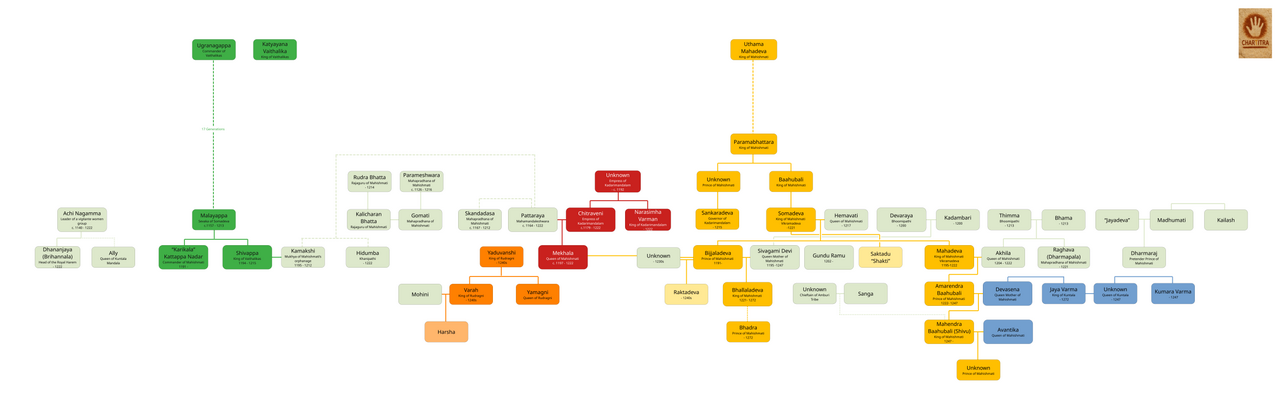
The story is set in the Mahishmati kingdom and is about two warring brothers for a kingdom. Rajamouli said he was inspired from the epic Mahabharata. The protagonist's name, Baahubali, refers to the amount of power the protagonist possesses, according to producer Sobhu
Reader's Guide
The Baahubali franchise is significant for its impact on Indian cinema, widely regarded as the most important and influential films in the history of Indian cinema. It started a new film movement called pan-Indian film, breaking language barriers and achieving commercial success across India. The duology became the highest-grossing film in India of all time and is currently the third highest-grossing film franchise in India. The films received widespread critical acclaim both in India and worldwide. The franchise expanded into animated series, a graphic novel, and a trilogy of novels, demonstrating its cultural reach. The production involved extensive effort in sound design, period-accurate sets, and large-scale action sequences, including handling 2000 stuntmen and elephants. The franchise also faced controversies, including legal notices over the title Baahubali from Sodhe Matha, accusations of copying a video template, and criticism of the first poster's similarity to a Hollywood film poster. Despite these, the franchise remains a landmark in Indian cinema.
Did You Know?
- The franchise started a new film movement called pan-Indian film.
- The duology is currently the third highest-grossing film franchise in India.
- The first novel in the franchise, The Rise of Sivagami, was released on 7 March 2017.
- The animated series Baahubali: The Lost Legends premiered on 19 April 2017 on Amazon Prime Video.
Cultural Impact & the Pan-Indian Revolution
The Baahubali duology, directed by S. S. Rajamouli and produced under Arka Media Works, is widely regarded as among the most consequential works in the entire history of Indian cinema. Released in Telugu, the two-part saga transcended regional boundaries and effectively launched what is now known as the pan-Indian film movement, a fundamental shift in how Indian audiences consume and support cinema across language lines. The first installment, Baahubali: The Beginning, hit theaters on 10 July 2015, while the second, Baahubali 2: The Conclusion, arrived on 28 April 2017 and went on to become the highest-grossing film in India of all time. Together, the pair generated over ₹2,400 crore in worldwide revenue, cementing the franchise as the third highest-grossing film franchise in the country. Both entries earned widespread critical acclaim not only domestically but internationally, signaling that Indian storytelling could command global attention on a scale previously reserved for Hollywood blockbusters.
Production Scale & Craftsmanship
The making of the Baahubali films was an extraordinary feat of industrial filmmaking, with a joint production budget of ₹430 crore (approximately $65 million). Director Rajamouli and his team treated the project as a period epic in the truest sense. Production designer Sabu Cyril noted that every single prop—chairs, thrones, palaces, swords, armor, and costumes—was built from scratch, leaving no room for shortcuts. Action choreographer Peter Hein had to coordinate roughly 2,000 stunt performers and elephants for a single sequence, while sound designer P. M. Satheesh embedded microphones throughout sets to capture natural ambient audio, abandoning sync sound entirely to preserve authenticity. Actors Prabhas, Rana, and Anushka Shekar underwent intensive training in sword fighting, and Prabhas and Rana additionally learned horse riding. Even the foley work was outsourced internationally, with artist Philippe Van Leer recording at the Dame Blanche complex in Belgium in November 2014. Cinematographer K. K. Senthil Kumar brought a visual language befitting the grandeur, and the entire effort reflected a commitment to period-accurate spectacle that set new benchmarks for Indian cinema.
Creative Vision & Narrative Architecture
Rajamouli drew direct inspiration from the ancient epic Mahabharata when shaping the Baahubali narrative, which is set in the fictional kingdom of Mahishmati. The central conflict revolves around two brothers—Baahubali, portrayed by Prabhas, and Bhallaladeva, played by Rana—whose struggle for the throne forms the emotional spine of the story. The director explained that the tale of two warring siblings fighting over a kingdom was simply too vast for a single film; after attempting to compress it, the team realized they were sacrificing emotional depth, so the project was split into two releases separated by a ten-month gap. Rajamouli emphasized that the world is entirely fictitious, allowing him complete freedom to design weapons, costumes, and settings without historical constraint. For the Tamil-language version, lyricist Madhan Karky was brought in to write dialogues in chaste Tamil, deliberately echoing the grandeur of classic historical films like Manohara (1954) and Nadodi Mannan (1958). The narrative also carries a thematic echo of the Mahabharata's own dynastic tensions, with the more powerful Baahubali ultimately yielding the kingdom to his less powerful brother Bharata Chakravartin.
Franchise Expansion Beyond the Silver Screen
The Baahubali universe did not end with the two theatrical releases. The franchise expanded into multiple new media formats, including two animated series, a graphic novel, and a trilogy of novels published in English. The first novel, titled The Rise of Sivagami, was released on 7 March 2017, offering readers a deeper literary exploration of the world Rajamouli had built on screen. The animated series Baahubali: The Lost Legends premiered on Amazon Prime Video on 19 April 2017 and later aired on Colors TV on 10 December 2017, bringing the franchise's mythic storytelling to a broader streaming audience. This multi-platform rollout—spanning cinema, literature, animation, and digital streaming—demonstrated a deliberate strategy to extend the franchise's narrative reach well beyond the two films. Owned by Arka Media Works and created by Rajamouli, the franchise's expansion into these adjacent formats helped solidify its position as one of the most influential and commercially significant media properties in Indian entertainment history, with a combined worldwide gross exceeding ₹2,400 crore across its cinematic entries alone.
Gallery



Frequently Asked Questions
What is Baahubali?
Baahubali is a Telugu-language Indian film franchise consisting of two epic fantasy installments directed by S. S. Rajamouli and owned by Arka Media Works. The saga centers on the legendary warrior king Baahubali and his son Mahendra within the fictional kingdom of Mahishmati.
Who created and directed the Baahubali films?
Telugu filmmaker S. S. Rajamouli conceived, wrote, and directed both movies, serving as the primary creative force behind the franchise. The production is held under the Arka Media Works banner.
When were the two Baahubali films released and what was their budget?
Baahubali: The Beginning hit theaters on 10 July 2015, and Baahubali 2: The Conclusion followed on 28 April 2017. The pair was produced on a combined budget of approximately ₹430 crore, roughly $65 million at the time.
Why is Baahubali considered a landmark in Indian cinema?
The franchise is widely credited with igniting the pan-Indian film movement, in which a single-language production achieves blockbuster success across multiple linguistic regions of the country. It is regarded as one of the most culturally and commercially influential works in Indian film history.
What is the central story arc of the Baahubali saga?
The two films trace the heroic rise and tragic fate of king Baahubali, then follow his son Mahendra as he uncovers his true royal lineage. The narrative weaves together a father's legacy, a mother's devotion, and a son's quest for identity in the ancient kingdom of Mahishmati.
More in Indian film series 1-24
Spotted an error? Know more?
This is a living reference — every entry is fact-audited, and reader corrections feed straight into our audit queue. Suggest an edit · See this site's audit record